The machine used in the Pale Horse ritual
The Pale HorseThe machine used in the Pale Horse ritual is the apparent technical center of Thyrza Grey’s attempt to influence a person at a distance. Initially mistaken for a radio cabinet, it opens into a complicated electrical apparatus whose lights, controls, and humming operation lend modern form to the ritual. Mark Easterbrook’s changing response to it—from curious observation to alarm and then to skepticism—makes the machine a hinge between occult spectacle and the later explanation that the spectacle is a deliberate distraction.
Appearance and Placement
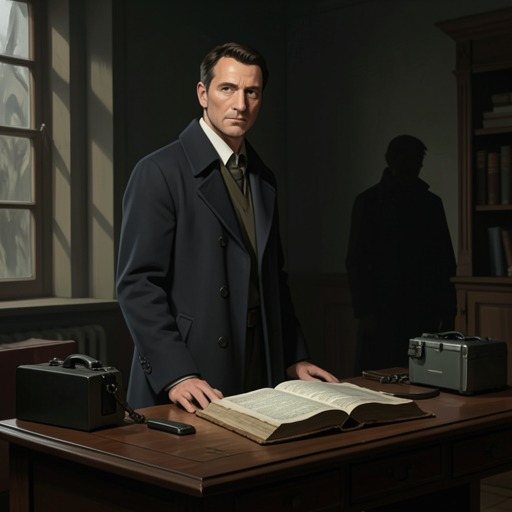
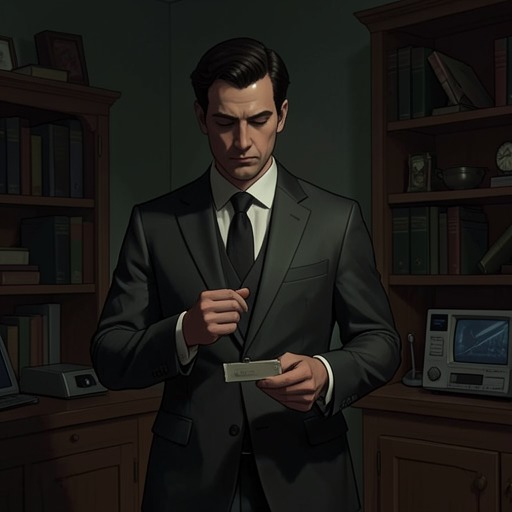
The apparatus first appears in the converted barn, a room whose ordinary identity as a library has been displaced by the arrangements for the ceremony. In its changed setting, a raised divan, a brazier, and a copper basin establish a ritual focus; the machine is introduced separately, disguised as something familiar and domestic. Its resemblance to a radio cabinet delays recognition of what it contains. When Thyrza opens it, Mark sees a large and complicated electrical contrivance rather than a conventional piece of furniture.
The machine is not fixed in place. It moves like a trolley, and Thyrza wheels it carefully into position beside the divan. That mobility makes placement part of its apparent operation: the apparatus is brought close to the figure on the divan only when the room and its participants have been prepared. The careful handling gives the device a practical, technical aspect, set against the chalk markings and spoken formulas elsewhere in the room.
Apparent Operation
Before the main ceremony, Thyrza tests a brown suede glove under a metal lamp with a gooseneck shade. Under its light, the glove changes in appearance, and she treats the result as evidence that it carries strong physical emanations from its wearer. Later, the glove is positioned by the machine, with a small violet light switched on beside it. The sequence links a personal object to the apparatus and suggests that the machine is meant to act on a particular person, not simply to produce a general effect in the room.
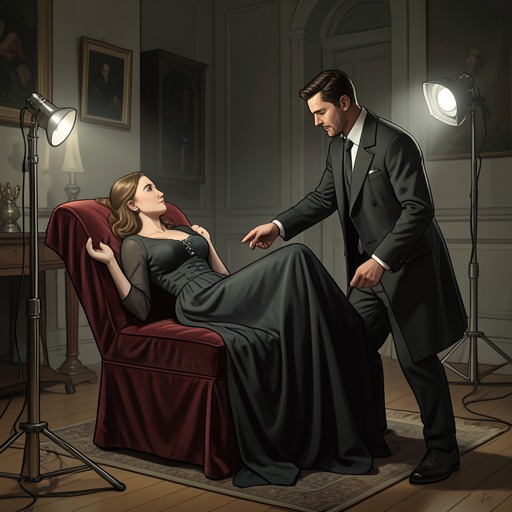
Thyrza adjusts the controls using a compass direction and degrees as reference points. The technical vocabulary and measured calibration supply an impression of precision, while the violet light and the apparatus’s eventual hum make its operation visible and audible. As the bulbs glow and the machine begins to hum, Thyrza directs a message toward Sybil Stamfordis, who lies on the divan. Mark feels himself affected by the scene and understands the box as potentially dangerous, though he cannot identify what it does. Its role at this point is therefore suggestive rather than demonstrated: the ceremony presents it as an instrument, but Mark has no independent proof that it can produce the effect claimed for it.
Ritual and Scientific Authority
The machine operates within a performance that combines different kinds of authority. Thyrza says that ritual can affect the human spirit, even when an observer dismisses its forms as empty. Bella Webb’s chalk markings, the white cockerel, and the chanting help establish a setting distinct from everyday life. Against these traditional-looking elements, the box supplies a modern counterpart: electrical components, controls, directional calculation, and lights. The contrast allows the ceremony to address both belief in occult practice and contemporary confidence in scientific explanation.
Mark’s attention shifts toward the apparatus because it seems to offer a material answer to the mystery. He wonders whether it might produce rays capable of acting on the cells of a particular mind. That possibility is his conjecture, not an established account of the machine’s workings. Mrs Dane Calthrop likewise accepts that something in the operation may be effective while distinguishing it from the surrounding trappings. She speculates that new knowledge could be adapted for unscrupulous purposes and notes that Thyrza’s father was a physicist. Neither observation proves that the box is the operative cause; together, they show how readily its technical appearance invites a scientific hypothesis.
Reversal and Narrative Significance
Mark’s later interpretation reverses the emphasis of the ceremony. He concludes that the trance, the white cockerels, the brazier, the signs, and the electrical box are all theatrical devices calibrated to different audiences. Occult imagery can impress the superstitious; the box can impress people who distrust spirits but are apprehensive about rays, waves, and psychological phenomena. In this account, its lights and hum are not evidence of a supernatural or scientific power but components of a convincing display. The machine can be examined and found harmless, allowing it to attract suspicion without exposing the actual means by which victims are killed.
This reversal gives the apparatus its decisive function in the plot. While it first seems to explain how Thyrza’s ceremony might reach beyond the room, Mark later sees it as a decoy that keeps observers looking in the wrong direction. The device is thus both an object within the ritual and a model of the ritual’s larger deception: its credible technical details turn uncertainty into apparent explanation, even as they conceal the true mechanism of the crimes. Its meaning depends on that gap between what the participants are encouraged to see and what the investigation must discover.